Palette-knife cities / 2026
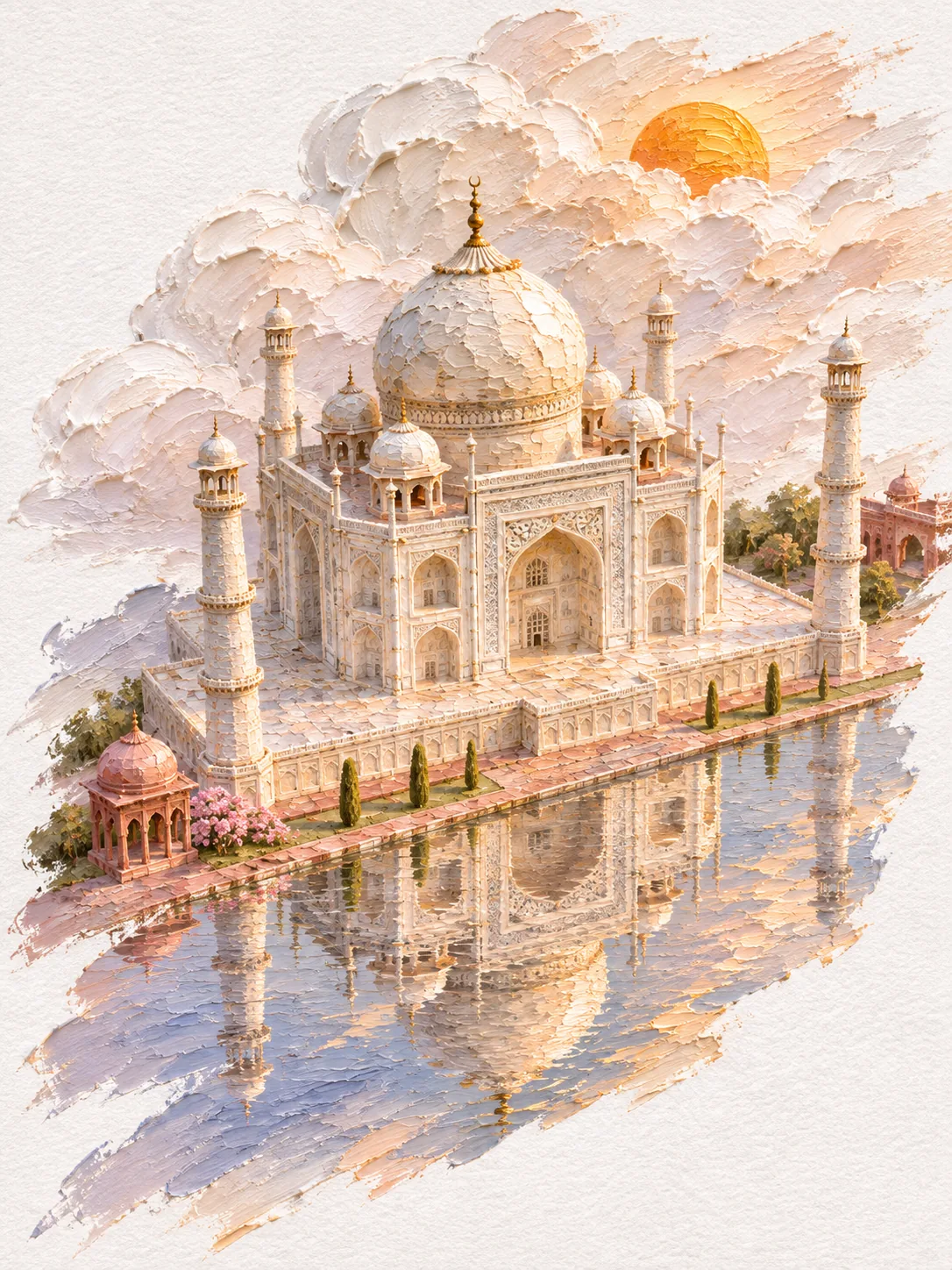
The Taj Mahal, white paint on white paper
The one landmark here whose colour is almost the paper's. The knife builds it in ridges of white, warmed by a sun rising out of the clouds.
The prompt sets every landmark in a large field of white textured paper, and lets the landmark's own colour lead the palette. With the Taj Mahal the two are nearly the same: white marble on white paper. The painting works with the difference that is left. There is the warmth of the sun on the dome, the grey-violet of the shadows, and the red sandstone of the pavilions at the edges.
Most of the shape is carried by the knife rather than by colour. The dome is laid in overlapping scales of paint, and the minarets are stacks of ridged white.
The prompt is a template: from one city to the next, only the name in square brackets changes. It is shown here in English translation.
[Agra · the Taj Mahal], oil painting style, a 3D miniature landscape in thick palette-knife impasto, with paint of varying thickness giving a real sense of volume. 3:4 portrait, a centred diagonal composition. The main colour comes from the landmark's own signature colours, or from the colours people associate with the city. A sweep of oil paint in matching tones runs from the lower left to the upper right, carrying the finely made landmark and rendering its iconic outline, structure and materials accurately, with a few related elements dotted around it. The paint at the bottom and the water in front echo the building's main colour; the water clearly reflects the whole landmark, keeping natural glints and layers of colour. Behind the building, milky-white clouds are built up from thick oil paint, varied in size and overlapping front to back, with clearly raised thickness, palette-knife texture and soft cast shadows, and an orange-gold sun rises between them. About a 45-degree oblique view from above, soft side light, a minimal layout, large areas of white textured paper left blank, the edges of the paint showing natural scraped and broken strokes. No text, no watermark.